
Obscura
Prove your alpha
Awards

The problem it solves
Obscura V2 - The Problem It Solves
What is Obscura V2?
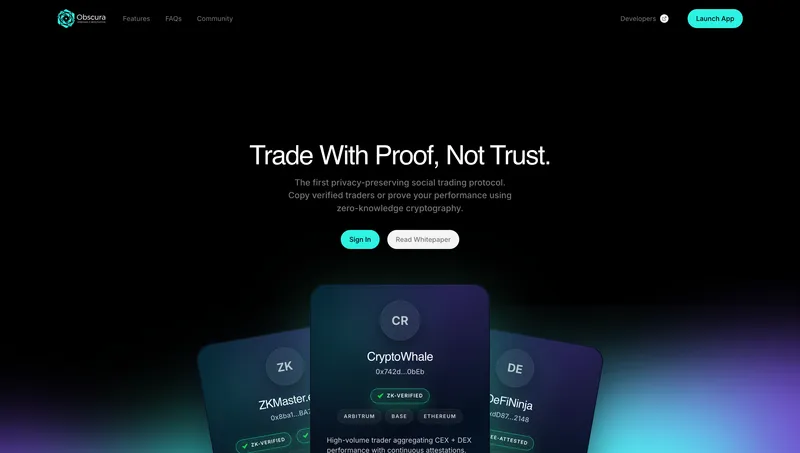
Obscura V2 is a privacy-preserving copy trading platform that enables users to follow and automatically replicate the trades of successful cryptocurrency traders without exposing sensitive trading data, wallet balances, or transaction histories.
Problems It Solves
1. Privacy in Copy Trading
Traditional copy trading platforms expose your trading activity, portfolio size, and strategies to centralized operators. Obscura uses:
- Zero-Knowledge Proofs (ZK) via Cairo/Ztarknet to verify trader performance without revealing actual trades
- Trusted Execution Environments (TEE) through the Citadel module to process sensitive data in secure enclaves
- Shielded Zcash payments for private subscription transactions
2. Trustless Trader Verification
Users can verify that a trader’s claimed performance is legitimate without the trader revealing their full trading history or wallet addresses. The platform generates cryptographic proofs of:
- Trade execution authenticity
- Portfolio performance metrics
- Historical ROI/win rates
3. Private Subscription Payments
Using Zcash shielded transactions, subscribers pay for premium trader signals without leaving a public payment trail. This protects:
- Subscriber identity
- Which traders they follow
- Subscription amounts
4. Cross-Exchange Trading
The platform supports copying trades across multiple exchanges (Binance, Bybit, OKX, Kraken, etc.) through a unified API gateway, with:
- Encrypted API key storage
- Multi-wallet management (EVM, Solana, Starknet)
- Real-time trade mirroring
How It Makes Tasks Easier/Safer
| Task | Traditional Approach | Obscura V2 Approach |
|---|---|---|
| Following traders | Publicly visible subscriptions, leaked strategies | Private subscriptions via Zcash, ZK-verified performance |
| Verifying performance | Trust screenshots/claims | Cryptographic proofs on-chain |
| Storing API keys | Plain text or weak encryption | TEE-protected Citadel vault |
| Paying for signals | Credit cards, public crypto txs | Shielded Zcash transactions |
| Executing copy trades | Manual or centralized bots | Decentralized workers with privacy |
Key Use Cases
- Retail traders can safely follow expert traders without exposing their capital or trading activity
- Professional traders can monetize their strategies while keeping alpha confidential
- Institutions can offer copy trading services with regulatory-compliant privacy guarantees
- Privacy-conscious users can participate in DeFi copy trading without on-chain footprint
Architecture Highlights
┌─────────────────┐     ┌──────────────────┐     ┌─────────────────┐
│   Frontend      │────▶│   API Gateway    │────▶│   Citadel TEE   │
│  (Next.js 15)   │     │   (FastAPI)      │     │   (Encrypted)   │
└─────────────────┘     └──────────────────┘     └─────────────────┘
                               │
        ┌──────────────────────┼──────────────────────┐
        ▼                      ▼                      ▼
┌───────────────┐    ┌─────────────────┐    ┌─────────────────┐
│  Verification │    │    Payments     │    │   Copy Trading  │
│  (Cairo/ZK)   │    │    (Zcash)      │    │   (Workers)     │
└───────────────┘    └─────────────────┘    └─────────────────┘
Summary
Obscura V2 solves the fundamental tension between transparency (needed for trust in copy trading) and privacy (needed for competitive advantage and security). It enables a marketplace where traders can prove their skill and subscribers can verify performance all without exposing the underlying data that makes those strategies valuable.
Challenges we ran into
Challenges I Ran Into Building Obscura V2
1. Docker Build Dependency Hell
The Problem
Building the E2E Docker stack revealed cascading dependency conflicts across multiple services:
React 18/19 Peer Dependency Conflict
npm error ERESOLVE could not resolve
npm error peer react@"^18" from @starknet-react/[email protected]
npm error   react@"19.0.0" from the root project
The Starknet React SDK required React 18, but Next.js 15 shipped with React 19.
Solution: Added --legacy-peer-deps to the npm install command in frontend/Dockerfile.dev.
Python Version Mismatch
ERROR: Package 'secretvaults' requires a different Python: 3.11.14 not in '>=3.12'The secretvaults package (Nillion’s privacy SDK) required Python 3.12+, but the Docker image used Python 3.11.
Solution: Upgraded the base image from python:3.11-slim to python:3.12-slim in the API Gateway Dockerfile.
Missing System Dependencies
error: command '/usr/bin/gcc' failed with exit code 1
secp256k1.h: No such file or directory
The secp256k1 cryptographic library needed pkg-config and libsecp256k1-dev to compile.
Solution: Added system dependencies to the Dockerfile:
RUN apt-get install -y pkg-config libsecp256k1-dev git2. Binary Distribution Issues
Zcash Wallet CLI Not Available
E: Unable to locate package zecwallet-light-cliThe zecwallet-light-cli wasn’t available in Debian repos, and the GitHub release didn’t have the expected version tag.
Solution: Downloaded the pre-built binary directly from GitHub releases with architecture detection:
RUN ARCH=$(uname -m) && \
    if [ "$ARCH" = "x86_64" ]; then ARCH_NAME="linux-x86_64"; \
    elif [ "$ARCH" = "aarch64" ]; then ARCH_NAME="linux-aarch64"; fi && \
    curl -L "https://github.com/AlenMalik/zecwallet-cli/releases/download/v1.0.0/..." \
    -o /usr/local/bin/zecwallet-cli
grpcurl Not in Debian Repos
E: Unable to locate package grpcurlNeeded for Zcash lightwalletd health checks, but not available via apt.
Solution: Downloaded directly from GitHub with architecture detection for ARM64/AMD64 compatibility.
3. Bun Lockfile Version Incompatibility
The Problem
error: Outdated lockfile. bun.lock (v1) is out of date
The lockfile was generated with bun 1.2.14
The verification service used Bun, but the lockfile version didn’t match the Docker image’s Bun version.
Solution: Removed --frozen-lockfile flag from bun install to allow lockfile regeneration:
RUN bun install # instead of: bun install --frozen-lockfile4. 600MB Build Context Transfers
The Problem
Docker was transferring the entire node_modules folder (600MB+) to the build daemon on every build, making iterations painfully slow.
Solution: Created .dockerignore files for frontend and verification services:
node_modules
.next
.git
*.log
5. Zero-Knowledge Proof Integration
The Problem
Integrating Cairo ZK proofs with the TypeScript verification service required:
- Compiling Cairo contracts to Sierra/CASM
- Deploying to Starknet testnet
- Calling verification from Node.js
Solution
Created a multi-stage build with:
- Cairo compilation in a Scarb container
- Bun service with
starknet.jsfor proof verification - gRPC endpoints for the backend to request verifications
6. TEE Key Management
The Problem
The Citadel module needed to store encrypted API keys for multiple exchanges, but key derivation had to happen inside the Trusted Execution Environment—not in application code.
Solution
- Used envelope encryption with TEE-derived master keys
- Implemented key rotation without re-encrypting all stored keys
- Added attestation verification before any key operations
Key Takeaways
| Challenge | Root Cause | Fix Time |
|---|---|---|
| React version conflict | Breaking changes in React 19 | 10 min |
| Python version mismatch | Upstream dependency update | 5 min |
| Missing binaries | Assuming apt availability | 30 min |
| Slow Docker builds | No .dockerignore | 5 min |
| Bun lockfile | Version drift | 5 min |
Lesson learned: Always check dependency requirements before assuming base images will work, and create .dockerignore files from the start.